Common Sleep Disorders: Symptoms, Causes & Health Effects
Insomnia, sleep apnea or something else? How common sleep disorders differ, what they do to your blood pressure and blood sugar, and when to see a doctor in Muscat.
 Written and reviewed by Dr. James Kumar Pallivathukkal, Specialist in Internal Medicine and DiabetesPublished 15 Oct 2026 · Reviewed by Dr. James Kumar Pallivathukkal on 15 October 2026 · 18 min readWhatsApp
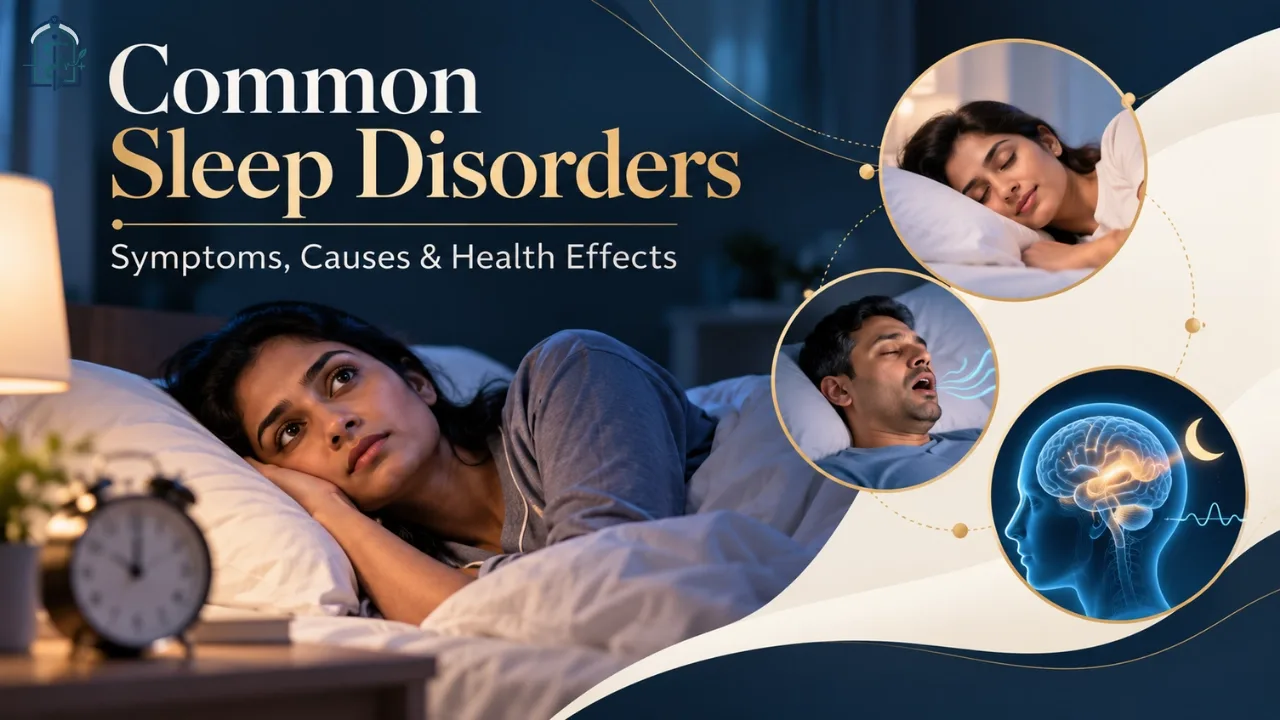
The sleep disorders doctors see most often in adults are insomnia (trouble getting to sleep or staying asleep), obstructive sleep apnea (breathing that repeatedly stops or becomes shallow during sleep, usually with loud snoring), restless legs syndrome (an urge to move the legs in the evening) and circadian rhythm disorders (a body clock that runs out of step with your day).
In this guide
- 1Why does sleep affect so much of your health?
- 2What are the most common sleep disorders?
- 3Sleep apnea or insomnia: how can you tell?
- 4How do sleep disorders affect the rest of your body?
- 5What causes sleep problems in the first place?
- 6How is a sleep disorder diagnosed?
- 7What tests might you need?
- 8How are sleep disorders treated?
- 9What everyday changes help?
- 10When should you see a doctor?
- 11Common myths about sleep
- 12Which guides go deeper on this topic?
- 13Final Thoughts
Long-term poor sleep is linked with high blood pressure, heart disease, type 2 diabetes, weight gain, low mood and road accidents. If sleep has been poor for several weeks and it's affecting your days, it's worth getting checked.
Most adult sleep problems come down to a small group of conditions: insomnia, obstructive sleep apnea, restless legs syndrome and problems with the body clock. They all leave you tired, which is why people mix them up. But the causes are different, the treatments are different, and some of them quietly affect your blood pressure, blood sugar and heart over the years.
A lot of people put up with bad sleep for a long time. They blame work, children, age or the heat. Sometimes that's fair. Quite often, though, there's a specific problem behind it that can be found and treated.
This guide walks through how the common sleep disorders differ, how they can affect the rest of your health, what a proper assessment involves, and when it's worth booking an appointment with a doctor in Muscat.
Why does sleep affect so much of your health?
Sleep is busy time for the body. Hormones are adjusted, tissues are repaired, memories are sorted, and the systems that control appetite, blood pressure and blood sugar are reset for the next day.
Most adults need at least seven hours a night. Falling short regularly matters, but so does broken, shallow sleep, even if the hours look fine on paper.
When sleep is poor night after night, a few things tend to happen. Stress hormones like cortisol stay higher. The body responds less well to insulin, so blood sugar can creep up. Hunger signals shift, and cravings for heavy, sugary food get stronger. Blood pressure, which should dip at night, may stay up. Concentration and reaction time slow down, and patience wears thin.
That list overlaps heavily with the conditions an internal medicine doctor looks after every day: diabetes, hypertension, obesity. It's one reason sleep comes up so often in routine consultations.
What are the most common sleep disorders?
There are dozens of recognised sleep disorders. A handful account for the vast majority of what adults actually experience.
Insomnia
Insomnia is difficulty falling asleep, staying asleep, or waking too early and not being able to drift off again, even though you have the time and a reasonable place to sleep. It also has to affect how you feel or function the next day.
Almost everyone has a bad patch at some point. A deadline, a family worry, a hospital stay or a long flight can throw sleep off for a week or two, and it usually settles by itself.
When it happens at least three nights a week and has gone on for three months or more, doctors call it chronic insomnia. By then the original trigger has often faded, and what keeps it going is something else: lying in bed watching the clock, dreading the night, sleeping in to "make up" for it. The worry about sleep becomes part of the problem.
Stress, anxiety and depression are common drivers. So are caffeine late in the day, nicotine, alcohol, irregular hours, screens in bed, pain, needing to pass urine at night, and some medicines.
Obstructive sleep apnea
In obstructive sleep apnea (OSA), the soft tissues of the throat relax and narrow the airway during sleep, sometimes closing it completely. Breathing becomes shallow or stops for a short time. Oxygen levels can fall, and the brain nudges you awake just enough to take a breath.
Those awakenings are usually too brief to remember. So someone with sleep apnea may honestly believe they slept through the night, yet wake up feeling as though they hardly slept at all.
The person with OSA is often the last to know. A wife or husband is usually the one who notices the loud snoring, the silences, and the sudden snort or gasp when breathing restarts. Other clues include:
-
Waking with a dry mouth or a dull headache
-
Falling asleep easily in front of the television, while reading, or as a passenger
-
Getting up several times a night to urinate
-
Heavy tiredness and poor concentration during the day
Carrying extra weight, especially around the neck and waist, raises the risk. So do being male, getting older, a family history, large tonsils or a narrow jaw, a blocked nose, smoking and alcohol in the evening. Women are affected too, particularly after menopause, and their symptoms can be less obvious. Tiredness, broken sleep or low mood may show up before any striking snoring does.
Restless legs syndrome
People with restless legs syndrome (RLS) describe an uncomfortable feeling in the legs, sometimes crawling or pulling or a deep ache, along with an urge to move them. It tends to arrive in the evening, when you finally sit down or lie in bed. Walking around helps, but only while you keep moving.
Unsurprisingly, it makes getting to sleep hard. RLS can run in families, and it's also linked with low iron, pregnancy, kidney disease and certain medicines. Checking iron levels is usually one of the first things a doctor does.
Circadian rhythm disorders
Your circadian rhythm is the internal clock that decides when you feel alert and when you feel sleepy. Trouble starts when that clock doesn't match the life you need to lead.
Some people are natural late sleepers to an extreme degree. They can't fall asleep until two or three in the morning and then struggle badly with early starts. This is called delayed sleep phase. Night-shift and rotating-shift workers can develop shift work sleep disorder, with poor sleep during the day and sleepiness on the job. Jet lag is the short-term version most people know.
In Oman, Ramadan is another time when routines move later: iftar, suhoor, prayers and family visits all push the night along. Most people adapt. For someone who already sleeps badly, it can make things noticeably worse for a few weeks.
Narcolepsy and other less common problems
Narcolepsy is a neurological condition in which the brain can't properly control the switch between sleep and wakefulness. The main feature is overwhelming daytime sleepiness, sometimes with sudden sleep attacks. Some people also get cataplexy, brief episodes of muscle weakness set off by laughing or other strong emotions. It needs specialist testing.
A few others are worth a mention. Parasomnias include sleepwalking, sleep talking and acting out dreams. Central sleep apnea is a different kind of breathing pause, where the brain doesn't send the signal to breathe; it's more common in people with heart failure, after a stroke, or with some medicines. Bruxism, grinding or clenching the teeth at night, often turns up first at the dentist.
Sleep apnea or insomnia: how can you tell?
This is the question behind a lot of sleep searches, and it's a reasonable one. Both conditions leave you drained. Both involve waking in the night. Some people have both at once, a combination known as COMISA (comorbid insomnia and sleep apnea).
The patterns tend to differ in a few ways.
| Often points to insomnia | Often points to sleep apnea | |
|---|---|---|
| What you notice | Lying awake, can't switch off | Sleeping, but waking unrefreshed |
| Snoring | Not a main feature | Loud and regular |
| What a partner sees | Tossing and turning | Pauses, choking or gasping |
| During the day | Tired but "wired," hard to nap | Very sleepy, dozes off easily |
| Mornings | Frustrated, low energy | Headache, dry mouth, groggy |
Treat this as a rough guide rather than a way to diagnose yourself. Plenty of people don't fit neatly into one column.
Getting the diagnosis right matters for a practical reason. Some sleeping tablets relax the throat muscles and can make undiagnosed sleep apnea worse. And a CPAP machine won't fix insomnia that's being driven by anxiety or years of habit. The treatment has to match the problem.
How do sleep disorders affect the rest of your body?
This is where sleep moves from being a quality-of-life issue to a medical one. The strongest evidence concerns untreated sleep apnea, but long-term insomnia matters too.
Can poor sleep raise blood pressure?
It can. In a healthy night's sleep, blood pressure falls. In sleep apnea, every pause in breathing drops oxygen levels and triggers a jolt of stress hormones, and blood pressure rises with each one. Repeated hundreds of times a night, that effect can carry over into the daytime.
Sleep apnea is a well-recognised cause of high blood pressure. It's one of the first things doctors think about when someone's blood pressure stays high despite taking several medicines.
Is sleep apnea linked to heart disease and stroke?
Yes. Untreated OSA is associated with a higher risk of atrial fibrillation (an irregular heart rhythm), heart failure, coronary artery disease and stroke. The repeated oxygen drops, pressure spikes and strain on the heart all play a part.
What about blood sugar and diabetes?
Short or broken sleep makes the body's cells respond less well to insulin, a state called insulin resistance. Over time, that can push blood sugar higher and raise the risk of type 2 diabetes.
If you already have diabetes, poor sleep can make control harder, and sleep apnea is common in people with type 2 diabetes and obesity. That's why a doctor reviewing your diabetes may ask, somewhat unexpectedly, whether you snore.
Does bad sleep make you gain weight?
It can nudge things in that direction. Sleep loss disturbs ghrelin and leptin, the hormones that manage hunger and fullness, so you may feel hungrier than usual. Being tired also makes exercise less appealing and snacking more so.
The link runs both ways. Extra weight raises the risk of sleep apnea, and sleep apnea makes weight harder to lose. Breaking that cycle from either side can help.
Mood, memory and safety
Insomnia and depression feed each other, and poor sleep makes anxiety, irritability and low stress tolerance more likely. Memory and decision-making slip too.
Then there's driving. Severe sleepiness slows reactions in a way that has been compared to drinking alcohol. If you've nodded off at the wheel, even for a second, or caught yourself drifting on a long drive, don't wait to mention it to your doctor, and stay off the road when you're that tired.
What causes sleep problems in the first place?
Usually several things at once.
Medical conditions are a big group: obesity, heart failure, acid reflux, chronic pain, asthma, COPD, thyroid problems, kidney disease and an enlarged prostate can all break up sleep. Stress, anxiety and depression are among the most common reasons for insomnia.
Daily habits count for a lot. Heavy meals late at night, tea or coffee in the afternoon, energy drinks, smoking, alcohol, bedtimes that change from day to day, and phones in bed all chip away at sleep quality. So does sitting still most of the day.
Some medicines affect sleep as well, including certain antidepressants, steroids, decongestants and some blood pressure tablets. If you suspect a medicine, talk to your doctor before changing anything. Stopping a prescribed medicine suddenly can cause its own problems.
How is a sleep disorder diagnosed?
It starts with a conversation, and a thorough one. Expect questions about when the problem began, what time you go to bed and get up, how long it takes to fall asleep, how often you wake, whether you snore, whether you nap, how much caffeine and alcohol you have, what your work hours look like, how your mood has been, and which medicines you take.
If you share a bed, bring your partner along or ask them what they've noticed. Their description of your snoring and breathing is often more useful than anything else.
Your doctor may ask you to keep a sleep diary for a week or two. Nothing complicated: roughly when you went to bed, when you think you fell asleep, when you woke, and how you felt in the morning. Patterns show up that are hard to see from memory alone.
Short questionnaires can help measure sleepiness and estimate the chance of sleep apnea. They're useful for guiding the next step, but they don't confirm anything by themselves.
What tests might you need?
What does a sleep study involve?
A sleep study records what your body does overnight. There are two main kinds.
A home sleep apnea test uses a small device you take home and wear in your own bed. It usually tracks breathing, airflow, oxygen levels and heart rate. For an adult in reasonable general health where sleep apnea is the main suspicion, it's often enough.
Polysomnography is the fuller version, usually done overnight in a sleep lab. As well as breathing and oxygen, it records brain waves, eye movements, muscle activity and heart rhythm. It's used when the picture is less clear, when another sleep disorder is suspected, or when a home test isn't suitable.
Will you need blood tests?
Blood tests don't diagnose most sleep disorders, but they can pick up things that make sleep worse or explain tiredness. Depending on your symptoms, your doctor might check iron and ferritin (especially if restless legs are a problem), thyroid function, blood sugar or HbA1c, kidney function, and a blood count to look for anaemia.
What about your smartwatch?
Sleep trackers are good at showing trends, like how regular your bedtime is, and some can flag unusual breathing. They aren't a medical sleep study, though. If your watch raises something worrying, take it as a prompt to see a doctor, not as an answer.
How are sleep disorders treated?
That depends entirely on which one you have, how severe it is and what else is going on with your health.
Treating insomnia
The first-line treatment for chronic insomnia is cognitive behavioural therapy for insomnia (CBT-I). It's a structured programme, usually a few weeks long, that tackles the habits and thoughts that keep insomnia going.
Some of it sounds counterintuitive. You keep the same wake-up time every day, weekends included. The bed is kept for sleep and intimacy only. If you can't sleep, you get up and do something quiet until you feel sleepy, rather than lying there fighting it. In some cases, time in bed is cut back for a while to rebuild a strong, natural drive to sleep. Alongside this, you learn ways to handle the worry that tends to show up at bedtime.
It takes some effort, but the benefits tend to last. CBT-I is offered by trained therapists, and there are also digital programmes.
Sleeping tablets have a place for some people, generally for short periods and alongside CBT-I rather than instead of it. They can cause next-day drowsiness and dependence, and in older adults they raise the risk of falls. Any decision about them belongs with your doctor.
Treating obstructive sleep apnea
For moderate to severe sleep apnea, CPAP (continuous positive airway pressure) is still the standard treatment. A small bedside machine blows a gentle stream of air through a mask, which holds the airway open while you sleep.
The first few weeks can feel strange. Getting the right mask and having someone to troubleshoot early problems makes a big difference to whether people stick with it. Those who do often say they hadn't realised how tired they'd been until the tiredness lifted.
Sleep apnea treatment without CPAP
CPAP doesn't suit everyone, and there are other routes. Which ones fit depends on your anatomy, how severe the apnea is and your general health.
Losing excess weight can reduce the severity of sleep apnea considerably in many people. A custom oral appliance, made by a dentist, holds the lower jaw slightly forward and can work well for mild to moderate cases. If your apnea mainly happens when you lie on your back, positional therapy may help. Treating a blocked nose, from allergies or a structural problem, is sometimes part of the plan.
For selected patients, surgery on the tonsils, palate, nose or jaw may be an option. Hypoglossal nerve stimulation is an implanted device that gently activates a nerve controlling the tongue, stopping it falling back into the airway. It's used in carefully chosen people who can't manage CPAP.
There's also a medicine option now, which is new territory. In late 2024, tirzepatide, a weight-management medicine that acts on the GLP-1 and GIP hormone pathways, was approved in the United States for moderate to severe obstructive sleep apnea in adults with obesity. Approval and availability vary from country to country, and it isn't right for everyone. It's something to discuss with a doctor who can look at your full medical picture.
Treating restless legs
Treatment often begins with fixing low iron if it's present and reviewing any medicines that might be making things worse. Regular exercise, stretching in the evening and cutting back on caffeine and alcohol help some people. When symptoms are frequent or severe, prescription treatment can be considered.
Treating body clock problems
Well-timed bright light, a fixed sleep schedule and, in some cases, carefully timed melatonin under medical guidance can help shift the body clock. Shift workers usually benefit from planning their sleep deliberately and making the bedroom properly dark and quiet during the day.
A word about melatonin
Melatonin is easy to buy and widely seen as harmless. It does have genuine uses, such as jet lag and delayed sleep phase. For ordinary chronic insomnia, the benefit is usually small.
Recent observational research has raised questions about whether long-term melatonin use could be linked with heart problems. Studies of that type can't show that one thing causes another, and the question is still being looked at. Still, if you've been taking melatonin every night for months, it's worth reviewing with your doctor instead of carrying on by default.
What everyday changes help?
Good habits won't cure sleep apnea or narcolepsy. They do support every treatment, and for mild insomnia they can be enough on their own.
Get up at the same time each day, even after a bad night. Step outside for some morning light. Stop caffeine by early afternoon, and remember that karak, iced coffee and many soft drinks count. Skip alcohol in the evening; it helps you drop off but makes the second half of the night worse, and it relaxes the throat muscles that are already causing trouble in sleep apnea.
Try to eat dinner a few hours before bed, particularly if reflux bothers you. Keep the bedroom cool, dark and quiet, which in Muscat usually means decent air conditioning and good curtains. Put the phone down well before bed, and give yourself some kind of wind-down, whether that's reading, stretching or prayer. Stay active during the day, but not with hard exercise late at night. And if you struggle to sleep at night, keep naps short or skip them.
When should you see a doctor?
See a doctor if:
-
Your sleep has been poor for more than a few weeks and it's affecting your days
-
Someone has noticed loud snoring, breathing pauses or gasping
-
You're very sleepy during the day despite spending enough time in bed
-
You've dozed off, or nearly, while driving
-
You have diabetes, hard-to-control blood pressure, obesity or an irregular heart rhythm along with sleep problems
-
Your legs won't settle at night
-
You depend on sleeping tablets or alcohol to get to sleep
-
Sleep is dragging down your mood, work or relationships
When is it urgent?
Get emergency help if sleep-related symptoms come with chest pain, severe breathlessness, fainting, sudden confusion, or signs of stroke such as a drooping face, arm weakness or slurred speech. If you're feeling so low that you've had thoughts of harming yourself, contact emergency services or someone you trust right away.
Who should you see first?
For many people, an internal medicine doctor is a sensible first stop. Sleep problems are often mixed up with diabetes, blood pressure, thyroid disease, weight, reflux or medicine side effects, and a physician can look at all of that together. From there, you can be sent for a sleep study or referred to a sleep specialist if the situation calls for it.
If you're in Muscat and aren't sure whether your tiredness is a sleep disorder, another medical problem, or a bit of both, an internal medicine consultation is a practical way to find out.
Common myths about sleep
"Snoring is harmless." Light snoring now and then usually is. Loud snoring most nights, especially with pauses, gasps or daytime sleepiness, can be a sign of sleep apnea and should be checked.
"A drink before bed helps me sleep." It may help you fall asleep. It also breaks up sleep later in the night and makes snoring and sleep apnea worse.
"I'll catch up at the weekend." A lie-in eases some of the tiredness but doesn't fully undo a week of short nights, and it shifts your body clock, which is partly why Sunday nights are so hard.
"Only overweight people get sleep apnea." Weight is a major risk factor, but slim people get sleep apnea too, because of jaw shape, airway structure, nasal problems or family history.
"Older people just need less sleep." Sleep does get lighter and more broken with age, but older adults still generally need seven to eight hours. Persistent poor sleep isn't something to accept as simply getting older.
Which guides go deeper on this topic?
-
Sleep Apnea or Insomnia? Why the Symptoms Overlap and How to Tell Them Apart
-
Is Melatonin Safe to Take Every Night? What the New Heart Research Actually Shows
-
Think You Might Have Sleep Apnea? A Step-by-Step Guide to Getting Evaluated
-
New Medication Options for Sleep Apnea: What Patients Should Know
-
Primary Care Doctor or Sleep Specialist? Who Should Manage Your Sleep Problem
Final Thoughts
Bad sleep is common, and it's easy to treat it as just part of life. It doesn't have to be. Most sleep disorders can be pinned down with a straightforward assessment, and treating them often improves more than just energy. Blood pressure, blood sugar and mood can all benefit.
If you've been sleeping poorly for weeks or months, or someone has told you that you stop breathing at night, talk to an internal medicine doctor in Muscat. Working out what's actually going on is the first step toward better nights.
Lungs, sleep and infections in Muscat: when to see an internist
Dr. James sees adults with sleep apnea and sleep problems at Badr Al Samaa Royal Hospital, Al Ghubrah, by appointment.

Key takeaways
- Insomnia, obstructive sleep apnea, restless legs syndrome and body clock disorders are the sleep problems adults run into most often.
- Insomnia and sleep apnea can feel similar but need different treatment, and some people have both.
- Untreated sleep apnea is linked with high blood pressure, heart disease, stroke, type 2 diabetes and accidents.
- Diagnosis relies on a careful history and sleep diary, with a home sleep test or lab study when needed.
- CBT-I is the recommended first treatment for chronic insomnia. CPAP remains the mainstay for moderate to severe sleep apnea, with several alternatives available.
- Loud snoring, breathing pauses or dozing at the wheel are good reasons to see a doctor soon.
Common questions
What is the most common sleep disorder in adults?
Insomnia is the most common. Most people go through short spells of it during stressful times, and a smaller number develop chronic insomnia lasting three months or longer. Obstructive sleep apnea is also very common but frequently missed, because the person often has no idea their breathing stops during the night. A partner's description of snoring and pauses is often the first real clue.
How can I tell if I have sleep apnea or insomnia?
With insomnia, you're usually aware of lying awake or waking too early. Sleep apnea more often shows up as loud snoring, pauses or gasping that someone else notices, plus heavy daytime sleepiness even after what felt like a full night. The two can overlap, and some people have both, so a doctor's assessment and, if needed, a sleep study are the reliable way to know.
Can sleep apnea cause high blood pressure?
Yes. Each pause in breathing lowers oxygen levels and triggers a rush of stress hormones that pushes blood pressure up. Over many nights, this can raise blood pressure during the day as well. Sleep apnea is a known cause of hypertension and is often looked for when blood pressure stays high despite several medicines. Treating it may help blood pressure control in some people.
Is poor sleep linked to diabetes?
It is. Short or broken sleep makes the body less responsive to insulin, which can raise blood sugar over time and increase the risk of type 2 diabetes. For people who already have diabetes, poor sleep can make control harder. Sleep apnea is common in type 2 diabetes, so it's worth mentioning snoring or daytime sleepiness at your next diabetes check-up.
Can sleep apnea be treated without a CPAP machine?
Often, yes, depending on severity and your individual situation. Options include weight loss, a custom oral appliance made by a dentist, positional therapy, treating nasal blockage, surgery for selected patients, and an implanted nerve stimulator for those who can't use CPAP. A newer medicine has also been approved in some countries for sleep apnea in adults with obesity. Your doctor can help you weigh these.
Do I need a sleep study to diagnose a sleep disorder?
Not always. Insomnia is usually diagnosed from your history and a sleep diary, without an overnight test. Sleep apnea generally does need a sleep study to confirm it, as do some other conditions such as narcolepsy. That might be a home test worn in your own bed or a more detailed overnight study in a sleep lab, depending on your symptoms and health.
Sources
- NHS: Sleep apnoea · nhs.uk
- NHS: Insomnia · nhs.uk
- NHLBI: What is sleep apnea? · nhlbi.nih.gov
This guide is for general information and does not replace a consultation. Editorial and medical review policy

Related areas of expertise


More in this guide series
 Sleep Apnea or Insomnia? Why the Symptoms Overlap and How to Tell Them Apart
 Is Melatonin Safe to Take Every Night? What the New Heart Research Actually Shows
 Think You Might Have Sleep Apnea? A Step-by-Step Guide to Getting Evaluated
 New Medication Options for Sleep Apnea: What Patients Should Know
 Primary Care Doctor or Sleep Specialist? Who Should Manage Your Sleep Problem
Keep reading


Snoring, insomnia, daytime tiredness
Book about thisRead about sleep apnea